 QuantHub
 QuantHub
 Support
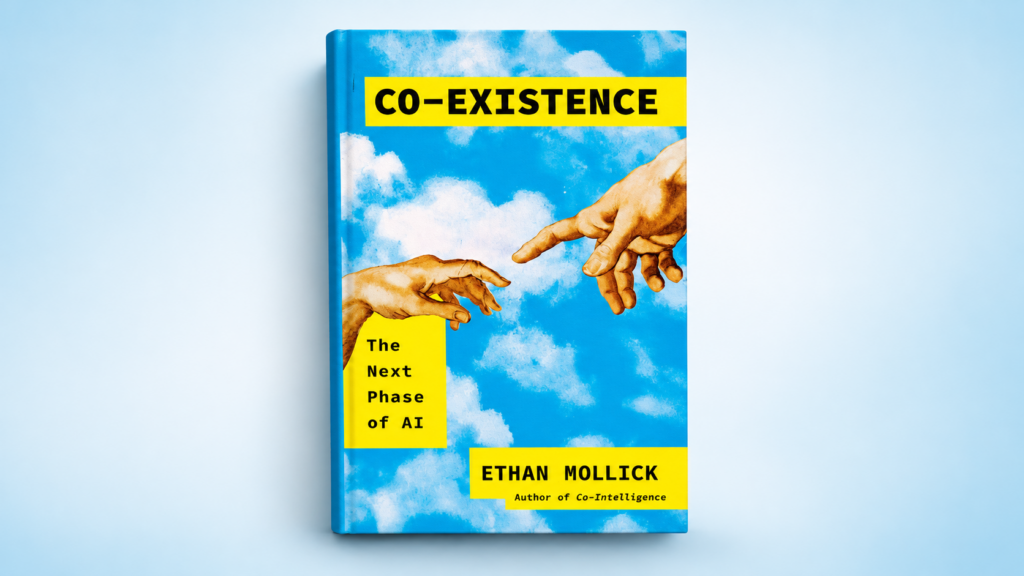
Here are a summary, two reviews depending on whether you plan to read the book or not (yes, there are actually spoilers), my opinion, and a list of concepts from the book for anyone who gets terminology FOMO (like me the first time I heard my kids say “FOMO”).
Summary
Co-Existence: The Next Phase of AI (2026) is the follow-up to Ethan Mollick’s bestseller Co-Intelligence: Living and Working with AI (2024). His new book is divided into three sections: the main body, the First Coda, and the Second Coda.
The first section primarily focuses on individuals’ relationship with AI, specifically living and working in a world saturated with agentic AI. One chapter provides a general overview of AI history through current topics like agents, reasoning models, and the abilities of bleeding-edge models.
The First Coda explores how the next phase of AI adoption will affect organizational structures, careers, education, and, ultimately, society. The Second Coda, telescopes out to a philosophical reflection on existence and the AI future. The book concludes with a detailed reference section organized by chapter for both directly cited and uncited sources.
Review for anyone planning to read the book (i.e., spoiler-free)
Punchline: It’s a fast read mostly about working as part of agentic AI teams.
Although Co-Existence sometimes contains quite a bit of technical information, it is a relatively easy read. Chapters have a speedy flow thanks to the frequent use of examples, restatements of previous ideas, and Mollick’s musings.
A recurring chapter pattern helps keep things moving: A) provide a scenario about a problem or research case study, B) explain a new term or concept (hence the long list at the end of this review), C) unpack how AI solves the problem, creates a new problem, or does both, and D) speculate about the future.
The first group of chapters offers guidelines for thinking about AI rather than practical tips; page 47 provides a nice summary. In his first book, he posited two ways to use AI: centaur work (the human guides, the AI does the labor) and cyborg work (melding your thinking with an AI).
In this new book, he introduces a paradigm shift to “conjurer work,” which means summoning AI, having it handle basically everything, and reviewing what comes back. What follows are discussions about agents’ strengths, like speed, scale, and pattern recognition, and how today’s work will be done by agentic teams.
He also explores how humans think and what is of value (e.g., “deep knowledge”) when partnering with AI. Throughout, he returns to the limits of LLM-based processing and the risks of relying on its predictions.
Significant sections of the book discuss agentic workflows, managing agents, and partnering with agentic teams. The major thrust of the book is about shifting our thinking from AI as a chatbot to AI as a team of more-than-capable colleagues… or even bosses.
Review for everyone else (i.e., spoilers o-plenty)
Punchline: Organizations, education, and society will be wildly transformed. The sweet spot of the book is Mollick talking about organizational change and AI.
Dark tones make a few, mostly brief, appearances in the first section of the book, but by Codas 1 and 2, darkness is a recurring theme. There are very promising notes, but the despair and fear that many feel today are more at prevalent—especially in the Second Coda. The codas are more speculative, which may invite more worry. In fairness, Mollick offers positivity as well, with moments of bright hopefulness that never feel Pollyanna.
Despite some of the darker tones, the book really hits its stride when Mollick talks about how organizations will change. This is no surprise, since his MBA, PhD, and research are about management and organizations.
Mollick argues that AI is breaking the structure of organizations in many ways:
- it creates gaps in the expert pipeline (no entry-level jobs eventually means no seasoned experts);
- removing workflow bottlenecks with AI is irrelevant if a single critical bottleneck remains (spoiler: it’s usually the humans);
- job titles and roles, siloed work, and compensation models must change;
- and a worker with an army of agents may be the future of business.
Education has changed, and Mollick argues that people will likely need more education in the future, not less, probably aided by AI in areas where it shines, like tutoring. The chapter on society is the most distant from Mollick’s areas of expertise (business, education) and leans more into pondering than earlier chapters.
Another spoiler is that sections of the book are written completely by AI. Mollick does not hide this, but he sometimes reveals it only after you have read the passage. And a few sections are his dialogue with AI.
For example, the Second Coda starts with Mollick asking Claude about the book so far. The response is very human-sounding and observant, and it even states, “Some of the advice in this book will be wrong by the time it reaches [the reader].”
The final spoiler is that the book ends with the AI apocalypse. The Second Coda presents two ways AI could go: it can be like an elevator that takes humans to new heights, or it can destroy the world, and Mollick spends time describing how the latter might happen. Appropriately, I guess, the end of humanity is the end of the book.
Opinion
If you read his first book, much of this will be familiar to you, like his jagged-frontier explanation of AI development. He revisits concepts like centaur and cyborg approaches to AI while adding a third approach called “conjurer” for agent use. Much of the alien-brain approach from his first book is also throughout.
The novel ideas mostly center on adapting your work style to integrate agents and considering what we can, could, and should bring to the AI-human partnership. If you are looking to further develop your own thinking about agents, consider some new angles, or learn some AI-related terms, this book may be for you.
However, if you read Co-Intelligence and already work with agents, this book likely will not offer you much beyond conjecture about the future and a few new terms (see the glossary below). If you only get a few minutes with a copy, read the chapter in the First Coda about organizations; it is the strongest section of the book and probably the seed for a future book.
The darker sections of Co-Existence do not add much beyond the common refrain that it could get bad. Whereas his first book offered a fresh way of thinking about using AI, this book offers a less clear framework and a lot of speculation.
It is definitely worth the read if you enjoy or need to stay up to date on public AI discourse, but it will likely not have nearly as much impact as Co-Intelligence. Sequels are often fun but fall short of the original, which is the case here.
(6 out of 10 stars)
Glossary
The terms below are mentioned in the book, some from industry or academia, and others coined by Mollick.
- Bitter Lesson—general methods like search and learning tend to beat approaches built around human expertise as computing power grows.
- Capability Overhang—the gap between what AI can do and how people use it.
- Cognitive Surrender—giving up decision-making to AI.
- Conjurer Work—summoning agentic teams to do work and meet goals.
- Dark Factory—when robots do all the work, so lighting is not needed (a dark office is implied).
- Deep Knowledge—knowing a field or topic through time, struggle, and mastery.
- Elevator vs. Eschaton–the idea that there are two AI paths. Elevator takes humans higher and higher and eschaton is the destruction of the world.
- Garbage Can Model—chaotic organizations where problems, solutions, people, and unwritten processes collide.
- Homework Apocalypse—how the advent of AI upended traditional homework like writing essays.
- Jackpot Savings—when the amount of time AI saves is significantly greater than the time it takes to instruct AI, use it, and review its output.
- Model Misalignment—when the goals of the AI being used do not align with the user’s goals or the task at hand.
- O-ring Automation—where the points of failure or bottlenecks keep changing because solving one issue with AI automation often reveals another.
- Reverse Centaur—AI is directing and people are doing.
- Secret Cyborg—covertly using AI to do your work.
- Vibe Work—vibe coding behaviors carried into other tasks, where the “worker” guides AI through instructions and feedback.
- Wide Knowledge—knowing the breadth of a field.
Bonus: Ironically, for a book about the benefits of working with AI, it has a surprising number of typos. I kept expecting a moment when Mollick would ask, “Humans should review AI output, so how many mistakes have you found?” I found seven.
