 QuantHub
 QuantHub
 Support
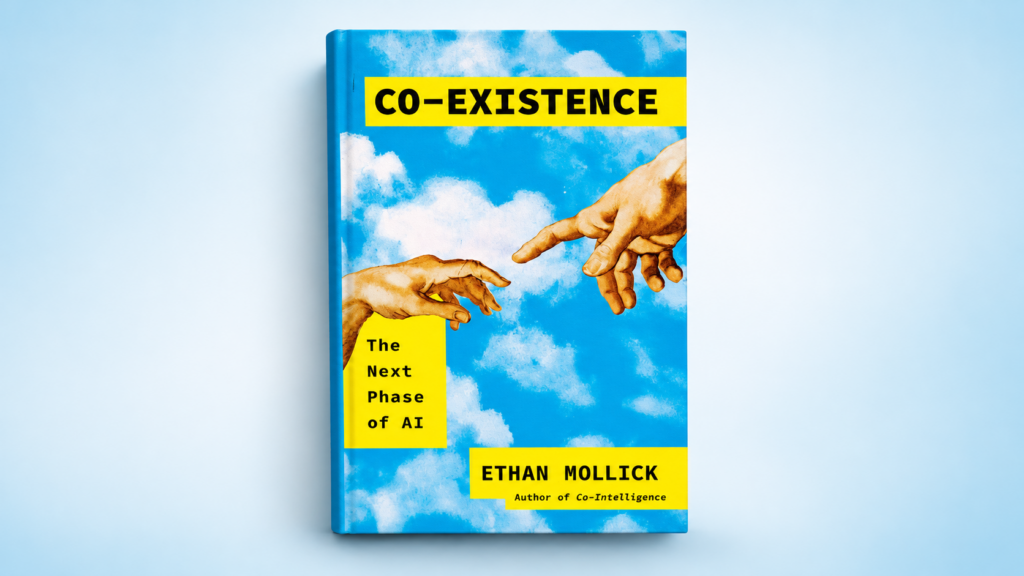
Co-Existence Book Review on AI Agents and the Future of Work
Key Takeaways
Ethan Mollick’s Co-Existence: The Next Phase of AI explores how people can work with increasingly capable AI while retaining judgment and autonomy. This review examines its strongest ideas, its limitations, and what they mean for AI literacy in higher education.
- The book expands from chatbot collaboration to delegating work to AI agents and evaluating their results.
- Its strongest material examines organizational change, workplace bottlenecks, and how people develop expertise.
- For instructors, a central question is how students learn to direct AI while retaining the knowledge to challenge it.
- The book is accessible and thought-provoking, though familiar ideas and speculative passages make it less distinctive than Co-Intelligence. Overall rating: 6/10.
How Co-Existence Builds on Co-Intelligence
Co-Existence, published in 2026, follows Mollick’s 2024 book Co-Intelligence: Living and Working with AI with a closer look at agentic AI and its implications for daily life. The main section considers how individuals work with AI, including its capabilities, limitations, and growing ability to complete tasks independently. Coda 1 widens the discussion to organizations, careers, education, and society. Coda 2 takes a more philosophical turn, exploring possible AI futures and the risks accompanying them.
A notable addition is “conjurer work.” In Mollick’s explanation of the shift to AI agents, centaur work divides tasks between people and AI, while cyborg work blends their contributions throughout the process. Conjurers delegate tasks to agents, provide direction, and evaluate what comes back. by Ethan Mollick The distinction matters because overseeing an agent requires a different kind of attention from guiding a chatbot through every step. People still need to define success and recognize when the result misses it.
Despite occasional technical passages, the book moves quickly. Examples and research scenarios introduce concepts before Mollick considers their consequences. Readers will find guidance for thinking about AI, rather than a detailed implementation manual. His familiar “jagged frontier” remains useful: AI can perform impressively on one task and struggle with another that appears simpler. Knowing a subject well enough to recognize those failures remains central to productive collaboration.

What the Book Gets Right About Work and Education
The strongest part of Co-Existence is its discussion of organizations. Mollick examines how AI could reshape job responsibilities, expose workflow bottlenecks, and disrupt the path from entry-level work to expertise. If organizations automate the tasks through which beginners learn, where will future experts gain experience? These questions give the book more substance than predictions about which jobs disappear. They ask readers to consider how work is organized and how professional judgment develops.
For higher education, that argument raises a practical challenge: students need opportunities to build the knowledge they will use to supervise AI. Producing a polished answer does not demonstrate that a learner can explain or defend it. QuantHub’s discussion of AI fluency and domain mastery explores a closely related concern. An instructor might apply this idea by asking students to develop an initial analysis, examine an AI alternative, and explain their revisions. The assignment would assess their reasoning as well as the finished work.
The later sections become more speculative and darker in tone. Spoiler note: Mollick includes AI-written passages and conversations with AI, and the closing discussion considers both beneficial and catastrophic futures. Those passages demonstrate the capabilities and uncertainty he describes, but they offer less practical direction than the organizational analysis. Readers who enjoyed Co-Intelligence will recognize several recurring concepts, and experienced agent users may find less new material than they hoped.
The book is worth considering for readers who want to think more carefully about AI agents, education, and organizational change. Its chapter on organizations is the standout; its broader speculation is less convincing. Co-Intelligence offered a clearer, fresher framework, while this sequel provides a useful but less distinctive continuation. The verdict: 6/10. It is an accessible contribution to the conversation, with its greatest value in the questions it raises about expertise and responsibility.

Glossary of AI and Agentic Work Concepts
These definitions clarify concepts discussed in the review. Some come from established research; others describe newer ways of working with AI.
- The Bitter Lesson: Richard Sutton’s argument that general methods such as search and learning tend to outperform approaches built around detailed human knowledge as computing power grows. His original essay explains the distinction.
- Capability overhang: The gap between what AI systems can do and what people actually use them to accomplish, as Mollick explains in The Overhang.
- Cognitive surrender: Accepting AI’s conclusions with little scrutiny, allowing them to substitute for independent reasoning.
- Conjurer work: Delegating tasks to AI agents, directing their work, and evaluating the results.
- Dark factory: A highly automated manufacturing environment that can operate with minimal human presence and little need for lighting.
- Deep knowledge: Subject expertise developed through sustained study, practice, and experience, including the ability to recognize mistakes.
- Garbage Can Model: An organizational theory in which decisions emerge from the interaction of problems, available solutions, participants, and opportunities to make choices.
- Homework apocalypse: A description of how AI’s ability to complete conventional assignments challenges their usefulness as evidence of student learning.
- Jackpot savings: Time savings that substantially exceed the effort required to instruct AI, review its output, and make corrections.
- Jagged frontier: The uneven boundary between tasks AI handles well and tasks it struggles to complete reliably.
- Model misalignment: A mismatch between an AI system’s behavior or objectives and the goals, constraints, or values it is intended to serve.
- O-ring model of jobs: A view of work as a set of essential, interdependent tasks. Failure in one can undermine the entire result, leaving a role for human expertise where AI remains unreliable.
- Reverse centaur: A work arrangement in which AI directs the process and people perform the tasks it assigns.
- Secret cyborg: Someone who uses AI to help complete work without disclosing that assistance.
- Vibe work: Guiding AI through goals and iterative feedback to produce work, extending the approach associated with vibe coding to other tasks.
- Wide knowledge: Breadth across subjects that helps someone recognize connections, ask useful questions, and identify new applications.

Bring AI Judgment Into the College Classroom With QuantHub
The questions raised by Co-Existence give instructors a starting point for teaching AI literacy: What should students delegate, how should they check the results, and which decisions should remain theirs? QuantHub helps colleges address these skills through modular curriculum that fits existing learning objectives and assignments. Its guide to integrating AI into college courses shows how focused activities can support AI literacy within the courses instructors already teach.
QuantHub AI Literacy includes seven modules and 36 assessable learning objectives covering topics such as AI failures, workflow decisions, responsible delegation, and oversight. QuantHub Instructors could pair those lessons with a business case that asks students to evaluate an AI recommendation and justify where human review is needed. QuantHub’s curriculum development process combines expert review with support for LMS integration, grade passback, and faculty onboarding, helping connect that learning to existing teaching workflows.
With the AI Literacy Certificate and Digital Badge launching in Spring 2027, students can also document their demonstrated skills through a shareable credential. Request a QuantHub demo to explore how AI literacy can fit your syllabus and help students practice the judgment they will need in the workplace.