

 Sign in
Imagine you’re stepping into a mobile phone store. As you enter, you’re greeted by a vast display of smartphones. Hundreds of models from various brands are sprawled across the shelves, mingling without any discernible order. It’s a chaotic sight, leaving you unsure of where to begin your search for the perfect phone.
Now, let’s consider a different scenario. You walk into another mobile phone store, but this time, the devices are meticulously organized. Each phone has its designated section, with clear labels indicating the brand, model, features, and price range. You effortlessly navigate through the store, quickly narrowing down your options to the desired specifications. Within minutes, you find yourself holding a promising phone in your hands.
Both stores offer the same quantity of information—countless mobile phones. However, it’s the organization of this information, the metadata, that determines whether you feel overwhelmed or can easily find what you’re looking for.
Why understanding your data matters
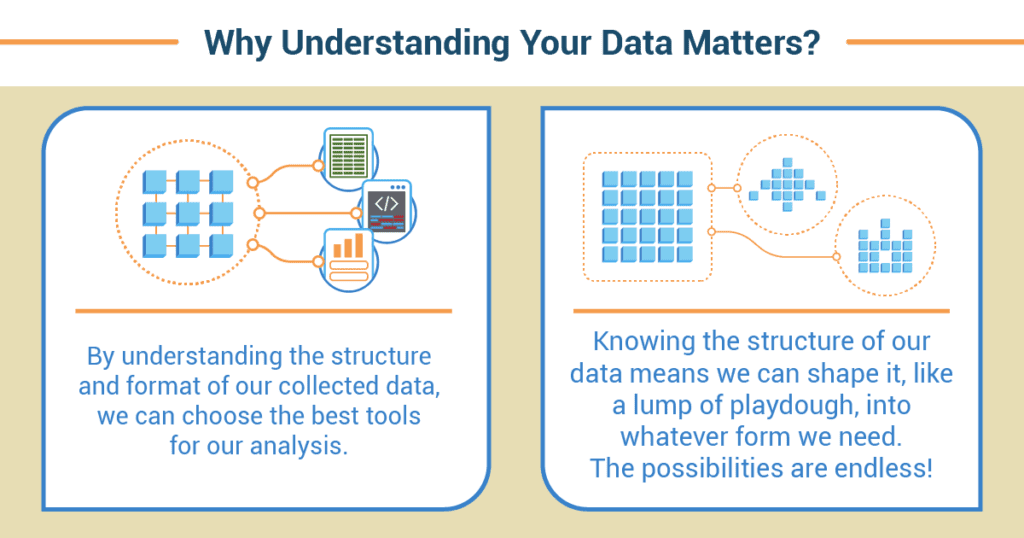
- By understanding the structure and format of our data (are the favorite toppings listed by name? By popularity?), we can choose the best tools for our analysis.
- Knowing the structure of our data means we can shape it, like a lump of playdough, into whatever form we need. We could sort it alphabetically to find the most and least popular toppings quickly. We can filter it to see if tenured employees have different topping preferences than newly hired employees. We can aggregate it or reshape it to derive meaningful insights. The possibilities are endless!
Use metadata to explore the structure and format of your data
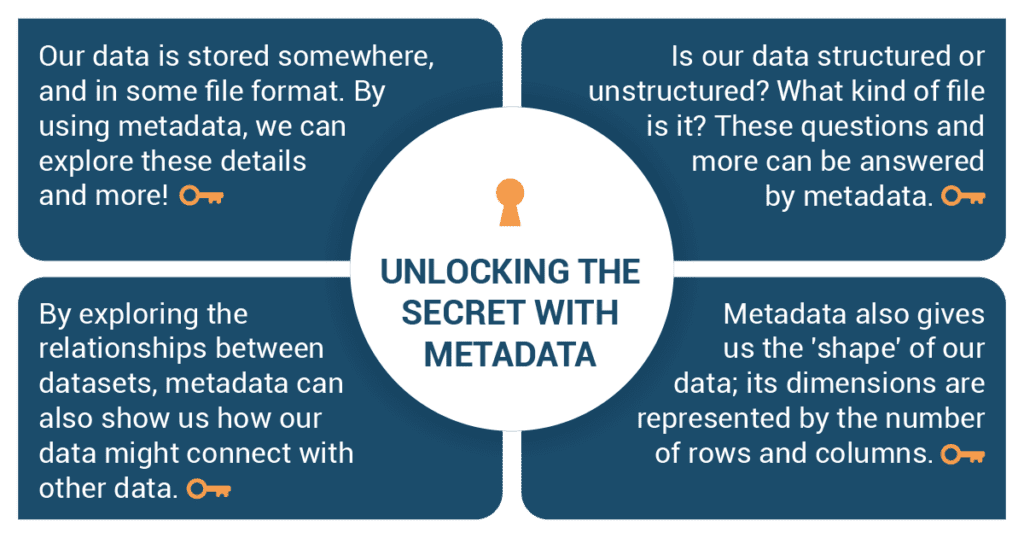
- Explore how data is stored. Our data isn’t just a list of pizza toppings. It’s stored somewhere (on a computer, in the cloud) and in some format (maybe as a spreadsheet or a text document). By using metadata, we can explore these details and more.
- Is our data structured (organized like a table) or unstructured (more like a big messy pile of toppings)?
- What is the file type (CSV, Excel, etc.)? Different file types have specific structures and encoding methods. Understanding the file type helps in interpreting the data correctly.
- Explore the relationships between datasets. Metadata can also show us how our pizza toppings data might connect with other data. Maybe we have another dataset that tells us which toppings are most healthy or cheapest. By exploring the relationships between datasets, we can create a full picture of our pizza party plan.
- Explore the dimensions or shape of your data. Metadata gives us the ‘shape’ of our data, the different aspects or variables that are being measured or observed within a dataset. Just like a pizza can be round or square, our data has dimensions. These are simply the number of rows (like the number of students surveyed) and columns (like different toppings they could choose).
Top Tips and Tricks with Metadata
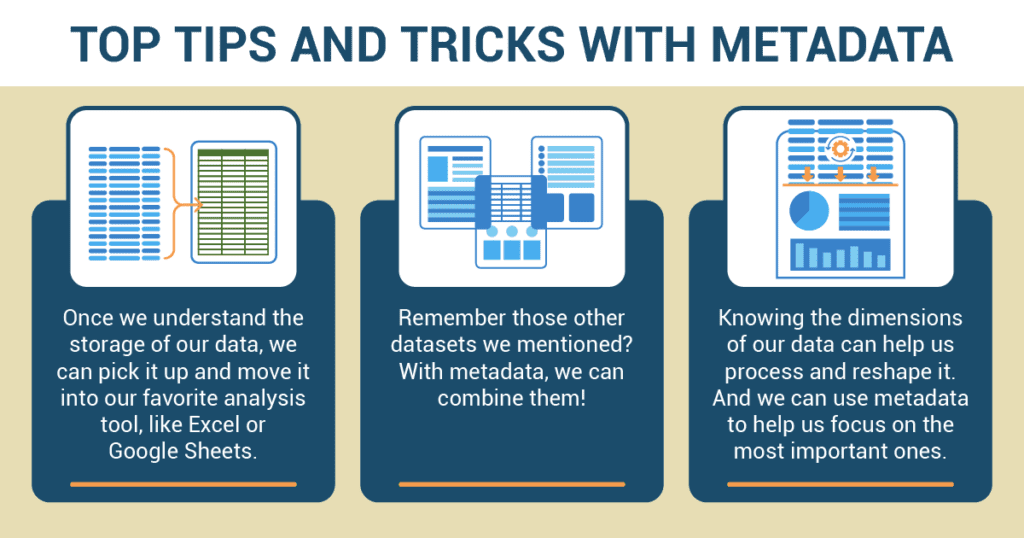
Once we understand the storage of our data, we can pick it up and move it into our favorite analysis tools, like Excel or Google Sheets.
And remember those other datasets we mentioned? With metadata, we can combine them! It’s like adding more toppings to our pizza. We can see if the most popular toppings are also the most expensive or the least healthy.
Finally, knowing the dimensions of our data can help us process and reshape it. If we have too many toppings to look at all at once, we can use metadata to help us focus on the most important ones.
Optimizing Food Delivery Operations through Metadata Analysis
In the bustling world of food delivery, efficiency and customer satisfaction are paramount. One global food delivery giant, “QuickBite,” found itself facing operational challenges due to the sheer volume of data generated daily. To address this, the company turned to metadata analysis to uncover hidden insights and streamline its delivery processes.
QuickBite’s delivery network spans across cities, with a complex web of restaurants, delivery drivers, and hungry customers. As the company grew, so did the volume and variety of data generated. Traditional analysis methods struggled to cope with the scale, leading to delays in order fulfillment, driver assignments, and inaccurate delivery time estimates. QuickBite needed a solution that would provide a holistic view of their operations while enabling quick decision-making. Recognizing the need for a data-driven approach, QuickBite’s analytics team decided to harness the power of metadata. Metadata, often referred to as “data about data,” contains valuable information about the structure, source, and context of the raw data. In this case, the team focused on metadata related to orders, drivers, restaurants, and delivery locations.
By delving into the metadata, QuickBite’s analysts were able to:
- Optimize Driver Assignments: By analyzing metadata related to driver availability, location, and historical delivery performance, QuickBite gained insights into the most efficient driver assignments. This reduced delivery times and improved customer satisfaction.
- Enhance Delivery Route Planning: Metadata about delivery locations, traffic patterns, and historical delivery times allowed QuickBite to develop more accurate delivery routes. This optimization minimized travel distances and ensured hot meals reached customers promptly.
- Real-Time Tracking Accuracy: QuickBite utilized metadata to enhance real-time tracking accuracy. By analyzing GPS data from drivers and cross-referencing it with historical metadata, the company improved the precision of estimated delivery times, reducing customer frustration.
- Restaurant Performance Insights: Metadata related to restaurant order volumes, preparation times, and customer feedback helped QuickBite identify high-performing restaurants. This allowed them to offer incentives to these partners and ensure a consistent dining experience for customers.
- Personalized Customer Experiences: QuickBite harnessed customer order history metadata to provide personalized recommendations, driving up sales and customer loyalty. Analyzing metadata about customer preferences and delivery locations helped the company tailor promotions and offers
Results and Impact:
By leveraging metadata analysis, QuickBite experienced a transformation in its food delivery operations. The company saw a significant reduction in delivery times, with an average decrease of 15%, leading to higher customer satisfaction ratings. Real-time tracking accuracy improved by 20%, and personalized recommendations resulted in a 12% increase in order values. Moreover, the optimized driver assignments and delivery routes led to a 10% reduction in operational costs.
Conclusion:
QuickBite’s journey exemplifies the power of metadata analysis in transforming a complex, data-driven business. By diving into the metadata surrounding their food delivery operations, the company not only overcame challenges but also created a more efficient, customer-centric delivery network. This case study demonstrates that, in the modern corporate landscape, leveraging metadata can unlock valuable insights and drive operational excellence.